

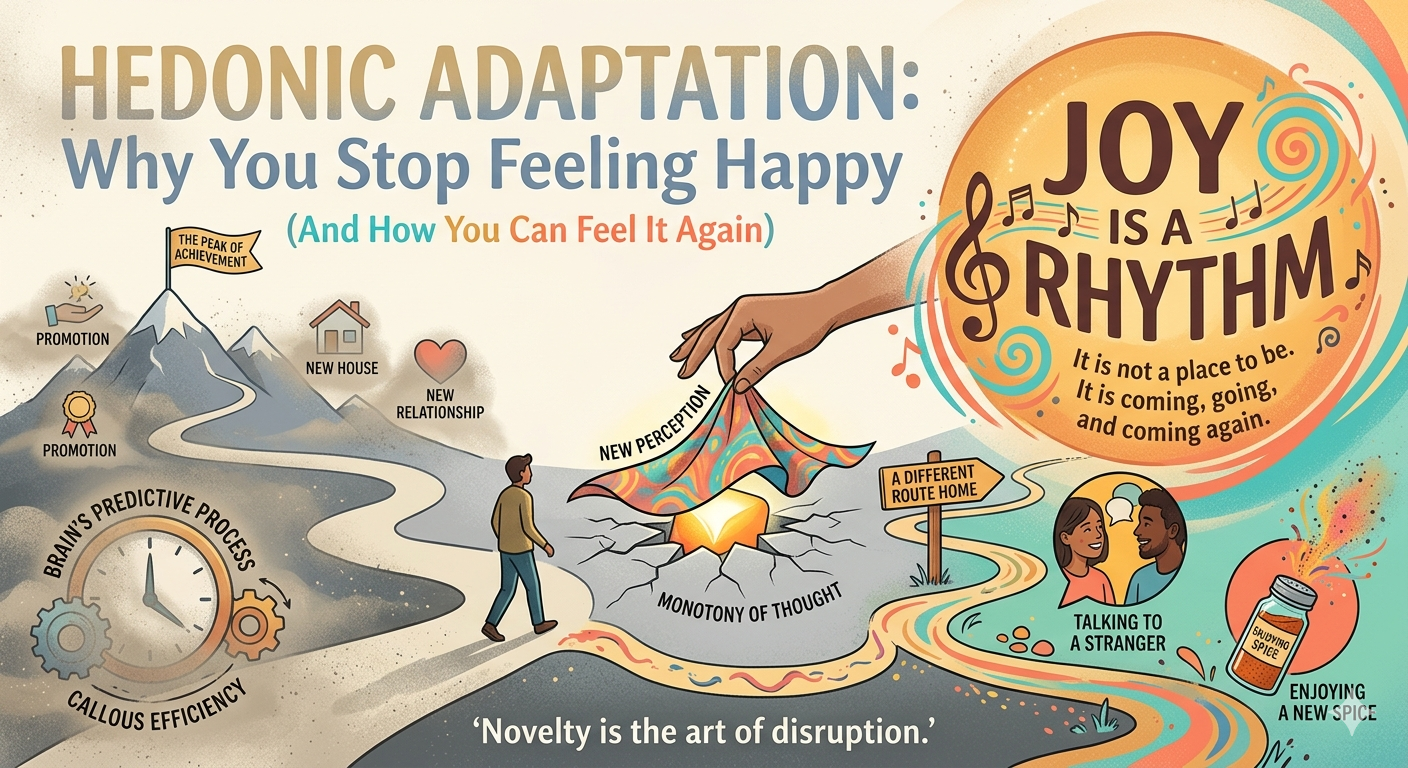
Why You Stop Feeling Happy (And How You Can Feel It Again)
Hedonic adaptation is a thief of wonder. It does not proclaim its arrival in any sort of fanfare. It sneaks up on us, like dust, slowly covering things that were once full of promise, full of life. Whether they were our belongings, our achievements, or our relationships, it slowly allows them to fade into the background of our minds. Not because they are any less worthy of our attention. But because our minds, in our constant pursuit of equilibrium, cannot rest with wonder.
We are animals wired to succeed. Our brains rationalize the miraculous with callous efficiency. The promotion, the new house, and the new love get reduced to a routine.
Our happiness gets reduced to routine as well, if we allow it. And we continue to chase, thinking that the next thing, the next acquisition, the next achievement will bring us the happiness we have been seeking all along. But we are unaware that the very mechanism we carry within ensures its evaporation.
But we can start a small rebellion. This rebellion does not entail accumulation. It entails perception.
New experiences, regardless of their seeming triviality, possess a certain power.
A different route home
Talking to a stranger
Enjoying a new spice
These are not great acts. They are acts that shatter the –
Monotony of thought
Predictive process of the mind
They are acts that bring the mind to life.
Novelty is not about scale. It is about disruption.
Novelty is the art of disruption.
The truth, however, is far more disconcerting. Happiness is not something that can be possessed. Happiness is something that can be rediscovered.
Without contrast, pleasure has no appeal. The brain does not cherish anything that can be predicted with complete certainty.
In other words, to pursue joy as a lasting experience is –
To pursue life with a sense of unfamiliarity
Perhaps the tragedy of the fleeting sense of joy is not that it is temporary. Perhaps it is because we need it to stay alive. But it has never been designed to do that. And in understanding that it does not, we find something much more profound. We find the power to experience life. To experience joy. To experience both again and again.
Joy is not a destination. It is not a place to be. It is a rhythm. It is coming, going, and coming again. And when you understand that it is this rhythm, you stop chasing happiness.
It is not the magnitude of what we experience, but the freshness with which we encounter it, that determines whether life feels vivid or merely repetitive.