

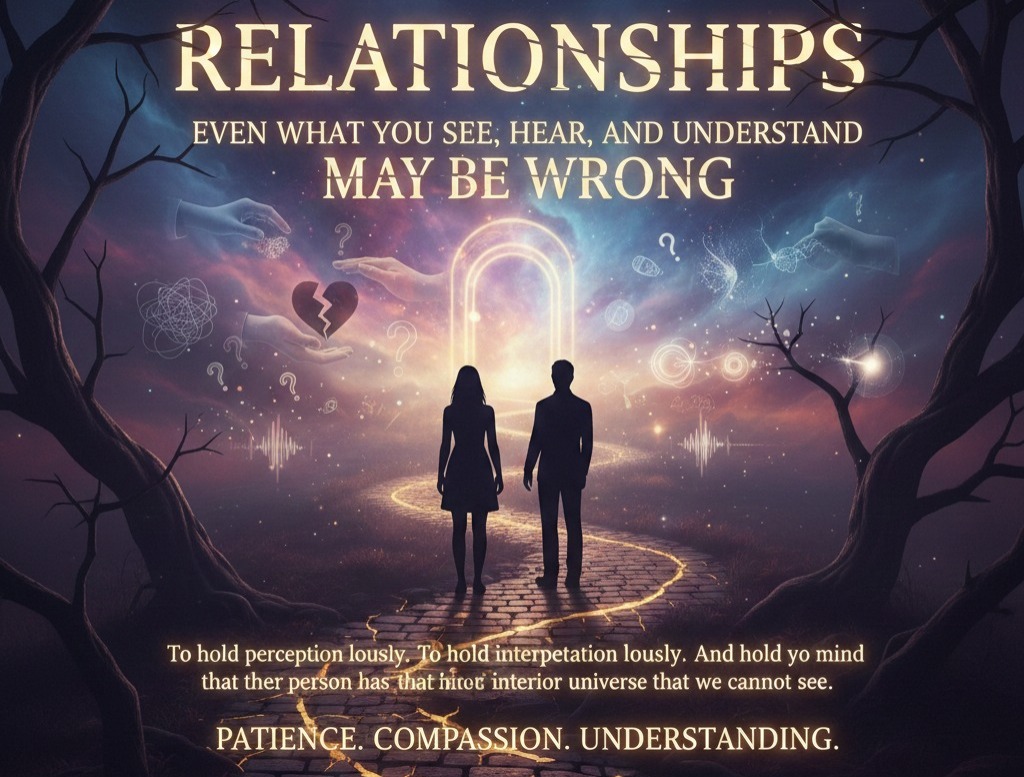
A relationship brings with it a host of feelings. Some good, some bad. Some give us butterflies. Others keep us awake at night, occupying our minds with endless thoughts, making us question the authenticity of love. The flowery road often hides rocky bumps, especially for those who look for them. Crossing those bumps requires self-reflection, strength, and a willingness to let go of your biases.
Yes, it’s not easy.
There are times in a human life when certainty shines so brightly that doubt seems like an insult. We believe what we see with our own eyes, the pattern of a familiar voice, and the silence with which our minds knit together little bits of sense. But our sense of reality is a delicate edifice. It is molded by memory, twisted by desire, and silently edited by fear.
What seems so immediate and true may actually be a very artificial illusion. Assembled not by reality but by circumstances or fragments of the tales.
However, there is a more philosophical play at work. Reality is not immediately felt by the human mind. It undergoes a translation. Every sight, sound, and gesture is subjected to a sequence of interpretations before it can make any form of sense. What we call truth is coherence. It is a sequence of events that seems internally coherent. But coherence is not truth. Coherence is comfort.
Doubting the senses is not a virtue. It is an unconscious awareness. It is the understanding that you are not complete. Those feelings may be confused with reality, and that certainty may creep in without warning. But by stepping back and making a decision to be curious rather than to react, you are breaking a cycle of misunderstandings.
A single honest question can save years of silent resentment. A willingness to listen can recover meaning from the ashes of assumption. These actions may seem insignificant. But their results extend across whole lifetimes.
Maybe wisdom means –
To hold perception loosely
To hold interpretation loosely, and
To hold in mind the fact that another person has an interior universe that we cannot see.
And perhaps only then can we develop patience. And perhaps it is in the patience that we can develop compassion.
Compassion allows us to move in a relationship with a natural rhythm. One guided not by illusion. But by the courage to seek understanding before assuming we have it.