

A Quiet Rebellion Against Determinism
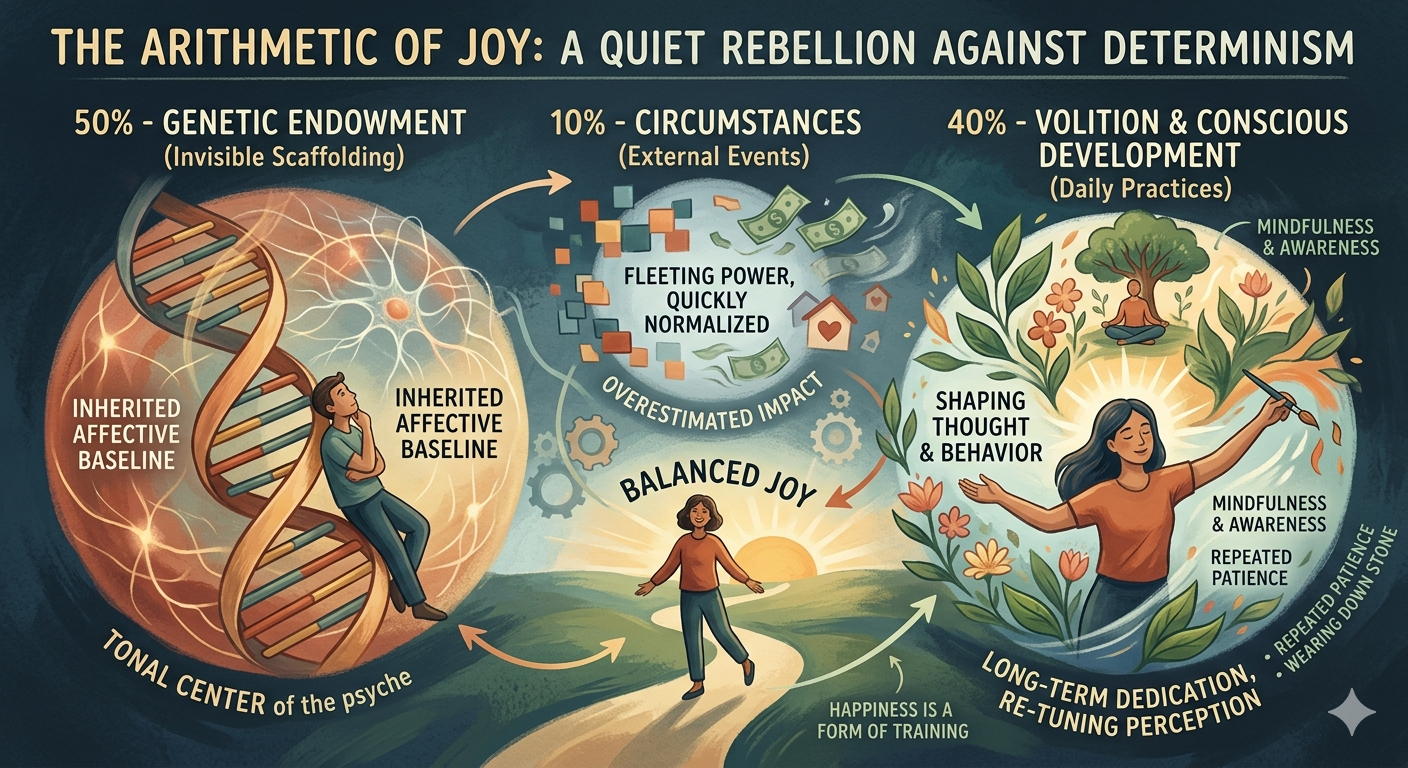
Happiness, which seems so elusive and misunderstood, cannot be boiled down to simplistic solutions. However, contemporary research in psychology offers a controversial dichotomy: Half of our emotional baseline is hardwired into our genes. And a small part is the result of circumstances.
The rest, amazingly, is open to conscious development.
The genetic endowment serves as an invisible scaffolding. It elevates people on certain affective scales. It determines the ease with which one experiences happiness or unhappiness. It is not this inheritance that determines destiny. But it speaks constantly in the back of the mind. It creates a tonal center to which the psyche tends to revert. Some are naturally suspended in a state of buoyancy. And some are struggling against the pull towards melancholy.
The circumstances are frequently overestimated in their impact. But they have a very limited effect on happiness. Money, social position, love affairs – these outward things have a fleeting power. They burst and then fade back into psychological habits. The human psyche, being adaptive to the point of absurdity, normalizes both abundance and deprivation. An object long desired soon becomes ordinary.
A calamity, which at first seemed so terrible, softens over time.
The most interesting part is the sphere of volition. This framework suggests that forty percent of happiness is created by consciously shaping patterns of thought and behavior. This field does not require any grandiose or dramatic revolutions. Rather, it welcomes an unspoken discipline. It is a long-term dedication to practices that re-tune perception. Mindfulness breaks the obsessive slipping into rumination and brings awareness to the present moment of experience.
The only thing that makes this part formidable is that it is immune to urgency. The development of inner balance is like the gradual wearing down of stone. And not a flash of light. It needs to be repeated. It needs to be patient.
Believe in change.
Change is the ultimate truth of life.
Most people give up on the quest too soon, lured by the availability of faster, external fixes.
There is an implicit challenge in this dispersion of power. It breaks the reassuring story that things will be all right as soon as everything is in place. It reveals the hopelessness of waiting until external conditions are configured in a perfect way.
It is impossible to recode the genetic code. Or to completely pre-program the accidents of life.
And yet in the silent domain of everyday routines lies a significant power to change.
Happiness, then, is not so much a goal as it is a form of training. It is a continuous bargaining between heritage, setting, and will.