

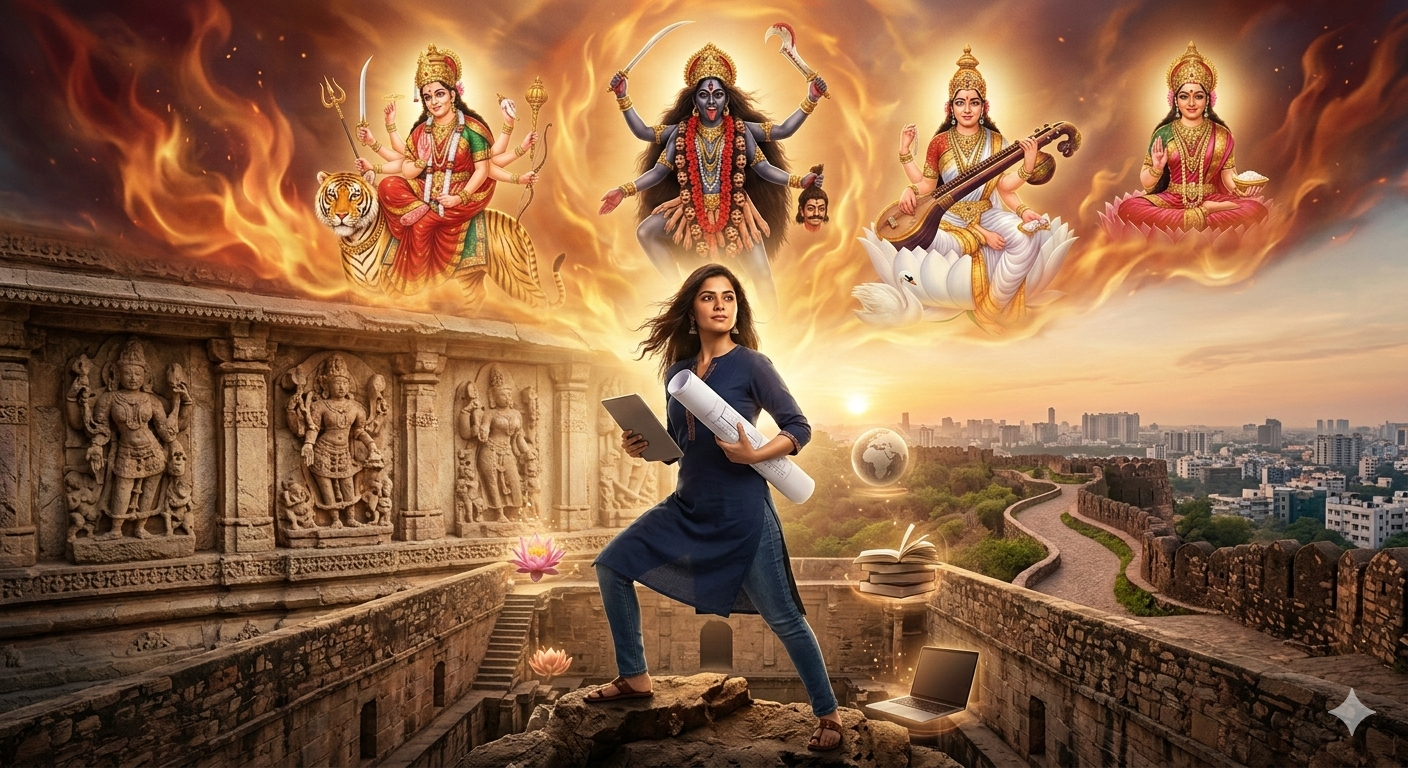
A Reflection on The Memory, Power, and the Silent Reawakening of the Feminine Soul
Cultures do not usually collapse through violence, but they are worn down by changed recollection. When a society loses its memory of the way it used to view its own roots, a faint distortion sinks into the consciousness of the masses. Distortion becomes truth over the centuries. Such was the destiny of womanhood in the Indian psyche.
Femininity was never perceived as weak in ancient Indian culture. Power was portrayed in the frightening beauty of Durga. Tyranny was annihilated by the cosmic wrath of Kali. Wisdom flowed through the peaceful existence of Saraswati. Food and nourishment flowed through the infinite generosity of Annapurna. Each of these forms expressed a very clear statement – femininity is both fierce and soft. It is both creative and destructive.
In womanhood, there is no room for weakness.
But history never moves kindly. Centuries of invasion, disruption, and political oppression created an air of fear and social withdrawal. Societies that previously glorified feminine authority slowly started to subjugate it. Cultural memory dimmed. The portrayal of the woman had changed from a sovereign presence to a guarded figure. Inherited confidence was broken down into wary reticence.
The change did not happen overnight. It sneaked in through institutions, language, and domestic demands. Gradually, there was a strange narrative that was created – the Indian woman is “abla,” a creature that is characterized as vulnerable. This description stood in sharp contrast to the same deities sculpted on temple walls and worshipped every day.
Irony lingered everywhere. A civilization that believed in paying homage to Durga during autumn festivals started questioning the strength of its own daughters. A community that called Kali the killer of demons started to represent women as helpless creatures who needed to be protected. The philosophical basis was preserved. But the psychological belief was lost.
Then history made its silent rectification.
The contemporary woman has started reclaiming the aspect that has never been fully withheld by tradition. In classrooms, laboratories, courts, studios, and areas of innovation, a new power is being formed. Her power is not an imitation of masculine power. Rather, it is the product of the ancient treasure – a memory of civilization rediscovering itself.
A modern woman juggles between roles that were not thought to be compatible. She beholds intellect that is honed through education, the emotional intelligence that is honed through experience, and the strength that is developed through centuries of silent persistence. The term superwoman explains such a phenomenon, but words are not enough to capture its enormity.
What we see today is not revolution but restoration.
All women bear in themselves an ancient lineage. And somewhere underneath social conditioning is that same elemental power which moved the figures of Saraswati and Annapurna, wisdom mixed with compassion, ferocity balanced by creation. The awareness of such inheritance changes the perception itself.
On this International Women’s Day, it is a fact that needs to be remembered – weakness was never an inherent quality of womanhood. It was a transient illusion perpetuated by historical circumstances.
Every woman has a horizon that is much greater than the definitions imposed on her. When she realizes that old heritage, reluctance fades away. Dreams do not limit themselves to inherited boundaries. The sky no longer acts as a boundary. It is just another gateway that is waiting to be crossed.
The fire was always there.
It was the memory that needed to be awakened.