

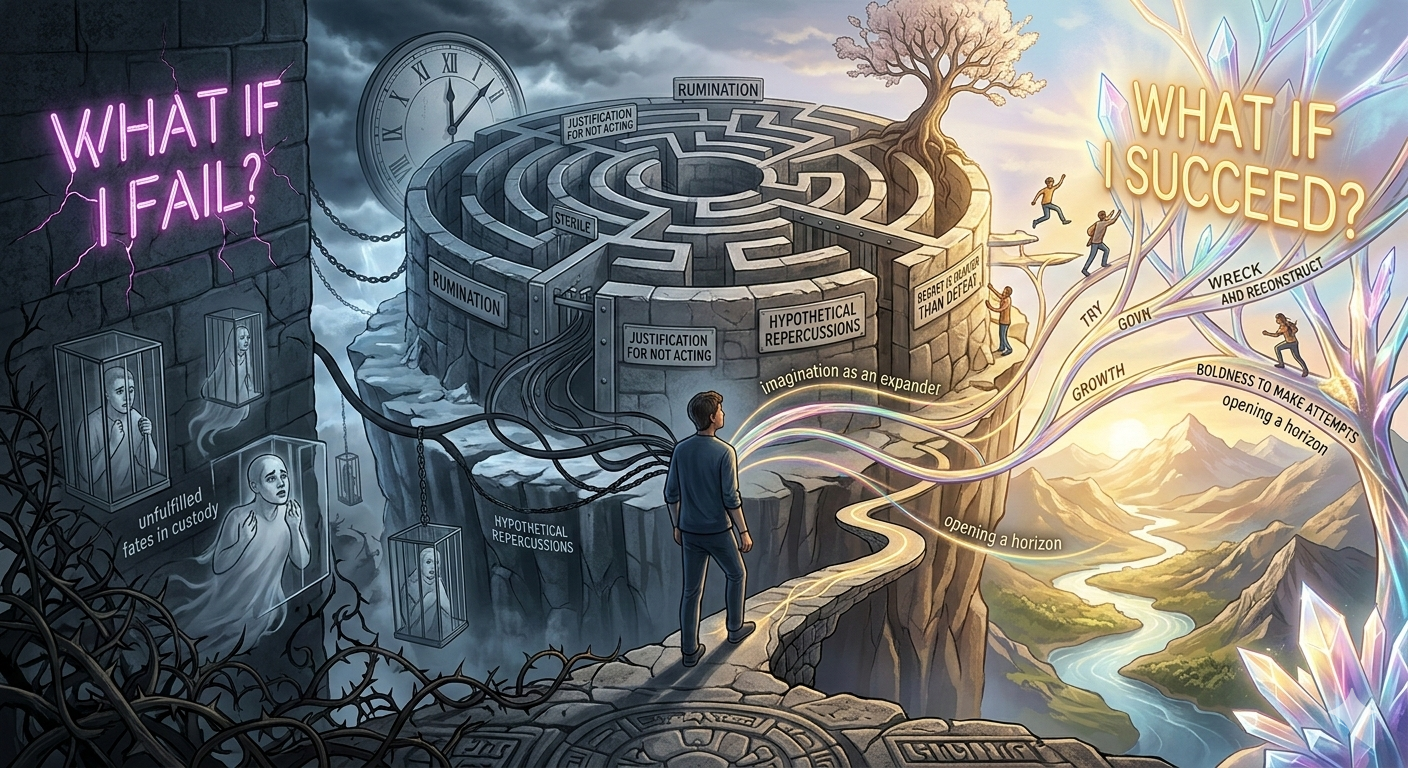
How envisioned disasters put unfulfilled fates in custody
There is a strange paralysis that is posing as prudence. It does not roar. It whispers. It comes in the guise of reason, wrapped in hypothetical visions, and lodges in the cavern of the mind. Its most popular catchphrase is the paragon of falsehood –
What if?
In these two simple, harmless words, there lies a whole architecture of ruin.
The human mind can create cathedrals of possibility with the help of its magnificent power. And the same mind often constructs the maze of unforeseen losses. One hypothetical doubt escalates to the stage of humiliation, defeat, incompetence, and social ostracism. The mind, in search of protection and security, turns into the troublemaker and the creator of hypothetical, self-destructive problems. The verdict is already given before any step is made.
The majority of people live in that sterile world of rehearsal. They are confused between rumination and preparation. They refine their justification for not acting with unbelievable arguments. All ambitions are put on trial, cross-examined, and eventually condemned by hypothetical repercussions. The tragedy is not in failure but in non-participation.
Trying and failing is an indication of involvement. To abstain from action is to submit to speculation.
The term “What if I fail?” hardly ever attempts to acquire information about anything. It is an attempt to escape. It creates a ghost future where shame seems to steer the order of things, and healing is unrealistic. The imagination, instead of being an expander, is a conserver of comfort. Security takes precedence over development. Stagnation disguises itself in the form of wisdom.
The imagination – instead of being an expander, is a conserver of comfort. The phrase “What if?” has neutrality in its structure. It is a portal and not a prophecy. The same mind that imagines disaster may also imagine success.
Another phrase, “What if I succeed?”, shares the same linguistic architecture. But it brings to life a completely different mental approach.
When experienced in life, failure is seldom poetic in nature. It comes devoid of melodrama. It is straightforward. It helps in recalibrating strategy. Once stung by failure, the pain goes away with remarkable haste. What stays much longer is the regret of unattempted possibilities.
Regret is heavier than defeat. Failure contains narrative. Regret contains emptiness.
Think of the metaphysical audacity to simply try. Action confirms the involvement in the uncertain dance of life. It embraces uncertainty as the entry fee to growth. Even a failed attempt is a witness of motion, of boldness, of an urge for adventure.
Lack of action proves the dominance of fear.
The imagination is like a magnifier. It is able to increase fear to the point of immobilisation or elevate hope to the point of reality. Amplification is a decision that is under conscious control. Every conjectural question may either build an obstacle or open a horizon.
The river of perceived failure seems very big since it is untried. Enter into it. And witness how its waters reveal unexpected abundance.
The boldness to make attempts breaks the despotism of imaginary failure.
Try. Collapse. Reconstruct. Advance.